- Find the y-intercept given
an equation in slope-intercept form
- y = 2x + 7
y-intercept = (0, 7) - y = -35x - 72
y-intercept = (0, -72) - y = -5x
y-intercept = (0, 0) - y = -3
y-intercept = (0, -3) - y = 4x - 11
y-intercept = (0, -11)
If an equation is given in slope-intercept form (y = mx + b), it is very easy to find the y-intercept because by definition the y-intercept of an equation in slope-intercept for is the point (0,b). In other words, if a linear equation or function is in slope-intercept form (or solved for y), the y-intercept is a point that has an x component of 0 (x = 0), and the y-component is the value that is not attached (multiplying) any variable. It is the constant b. Examples...
- y = 2x + 7
- Find the y-intercept given
an equation in standard or other form
- 2x + 4y = -8 --- (set
x=0)
2(0) + 4y = -8
4y = -8 --- (divide both sides by 4)
y = -2
y-intercept = (0, -2) - -3x + 5y = 11 --- (set
x=0)
-3(0) + 5y = 11
5y = 11 --- (divide both sides by 5)
y = 11/5
y-intercept = (0, 11/5) - -6y = 36 --- (no x, so
divide both sides by -6)
y = -6
y-intercept = (0, -6) - 7x + 31y = 13 --- (set
x=0)
7(0) + 31y = 13
31y = 13 --- (divide both sides by 31)
y = 13/31
y-intercept = (0, 13/31)
If an equation is given in standard form (Ax + By = C), there are two possibilities (putting the equation in slope-intercept form by solving for y and/or just setting x to 0 and solving for y). For the purposes of this conversation, I will look at the second option and set x = 0 and solve for y. Since I set x to 0, my resulting y-intercept is point that has an x-component of 0. The y-component is found by solving the resulting equation for y. Examples...
- 2x + 4y = -8 --- (set
x=0)
- Find the y-intercept(s) of
a graph
If only a graph is given, you are simply looking for the points where the graph crosses the y-axis (vertical axis). Again, the point is of the form (0, ?) where the question mark is replaced by the value(s) of y at which the graph crosses. Examples...
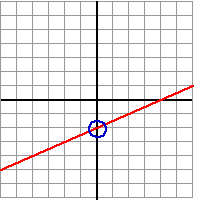
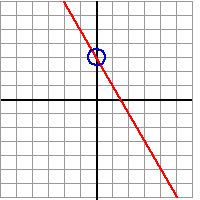
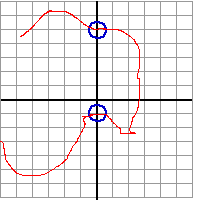
y-intercept = (0,-2) y-intercept = (0,3) y-intercepts = (0,5) and (0,-1)
- Find the x-intercept given
an equation in standard or other form
- 2x + 4y = -8 --- (set
y=0)
2x + 4(0) = -8
2x = -8 --- (divide both sides by 4)
x = -4
x-intercept = (-4, 0) - -3x + 5y = 11 --- (set
y=0)
-3x + 5(0) = 11
-3x = 11 --- (divide both sides by -3)
x = - 11/3
x-intercept = (-11/3, 0) - -6y = 36 --- (divide both
sides by -6)
y = -6 --- (horizontal line that does not intersect the x axis)
x-intercept = NONE - 7x + 31y = 13 --- (set
y=0)
7x + 31(0) = 13
7x = 13 --- (divide both sides by 7)
x = 13/7
y-intercept = (13/7, 0)
If an equation is given, there are two possibilities (solving the equation for x and/or just setting y to 0 and solving for x). For the purposes of this conversation, I will look at the second option and set y = 0 and solve for x. Since I set y to 0, my resulting x-intercept is point that has a y-component of 0. The x-component is found by solving the resulting equation for x. Examples...
- 2x + 4y = -8 --- (set
y=0)
- Find the x-intercept(s) of
a graph
If only a graph is given, you are simply looking for the points where the graph crosses the x-axis (horizontal axis). Again, the point is of the form (?,0) where the question mark is replaced by the value(s) of x at which the graph crosses. Examples...
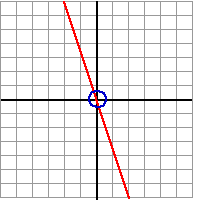
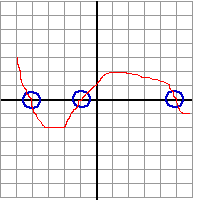
x-intercept = (4,0) x-intercept = (0,0) x-intercepts = (-4,0) , (-1,0) and (5,0)